
On November 3, 2026, Tiger Data and Inductive Automation put a new industrial historian into public beta, built on TimescaleDB Enterprise. Its product page lists "No tag or user limits" first among what every deployment includes, and its FAQ is blunt: "There are no tag- or user-based licensing limits."
You only lead with that when your buyers expect the opposite. In most plants, they do. The historian is licensed by tag, and every new sensor is a line on a quote.
I wanted to know how much of that is engineering and how much is habit, so I went to the primary sources: vendor documentation, published price lists, license terms, a public quotation and a public contract. This is what they say about what a historian is, how it is priced, and what adding a sensor actually costs.
A tag is the unit an engineer configures
A process historian is not just a database with timestamps. Its core object is the tag: one signal from one instrument, configured individually. AVEVA's license terms call it a "data stream" and its docs a "point"; Canary calls it a tag and defines it as a single stream of time-series data.
In AVEVA's PI Server, each point carries its own filtering settings. Exception reporting runs at the collector and drops values that stay inside a deadband (a band around the last reported value; changes inside it are not sent). The deviation is set "in the point's engineering units", and AVEVA's guidance is to set it "to a slightly smaller value than the precision of the instrument system" (docs).
Then the archive applies compression, which "follows the slope of the data (known as the swinging-door compression algorithm)", again with a per-point deviation that is "typically" set "to the precision of the instrument" (docs). When you read the data back, "the original signal is reproduced by interpolating between stored events" (docs).
That is good engineering. Store by exception, compress to the instrument's real precision, interpolate on read. It made sense when disk was expensive, and the per-tag tuning is a real piece of work that someone in the plant does, tag by tag.
It is also why the tag is the natural thing to put a price on. AVEVA's license terms say so directly: "Data streams are data tags or modules that are used by the Software to set up, configure, or store data or data structures" (AVEVA Software Schedule, PI System v1.5, June 2026, §3.3).
Historian pricing by vendor: PI System, Canary, TDengine, Proficy
Not every vendor publishes prices. These are the models as the vendors document them, checked on November 16, 2026.
| Vendor | What is licensed | Published prices |
|---|---|---|
| AVEVA PI System | Nodes and data streams (tags); adapters by connection plus data streams; client tools per user (license terms) | None published |
| Canary | Tags: "A single stream of time-series data, also referred to as points or items" | $9,970 perpetual license for 3,500 tags up to $135,500 for 100,000, plus 18% CustomerCare; larger by quote (pricing) |
| TDengine (All-in-One, the historian package) | Tags: "Asset/Device + Measurement Name" | Free to 5,000 tags; $46,000 a year for 100,000 (pricing) |
| GE Vernova Proficy Historian | Editions capped by tag count: 1,000, 50,000, 20,000,000 | None published (licensing) |
| Rockwell FactoryTalk Historian SE | Tag-count SKUs, including "1,000 Tag Add On" (cut sheet) | None published |
| Inductive Automation Ignition | The server, priced by the modules you add: "unlimited clients, tags, and projects" (docs) | Platform $1,200, Industrial Historian suite $3,500, per server (price list) |
| Tiger Data + Ignition Enterprise Historian | "No tag- or user-based licensing limits"; fixed-price perpetual through Inductive Automation, fixed price by server configuration for TimescaleDB Enterprise, usage-based on Tiger Cloud (page) | None published; public beta |
Per tag is the default. My read: the exceptions are recent, or they come from vendors whose core product isn't a historian.
What adding a sensor costs
Under tiered per-tag pricing, a new sensor doesn't cost a little more. It costs nothing until it crosses a tier boundary, and then it costs a lot at once.
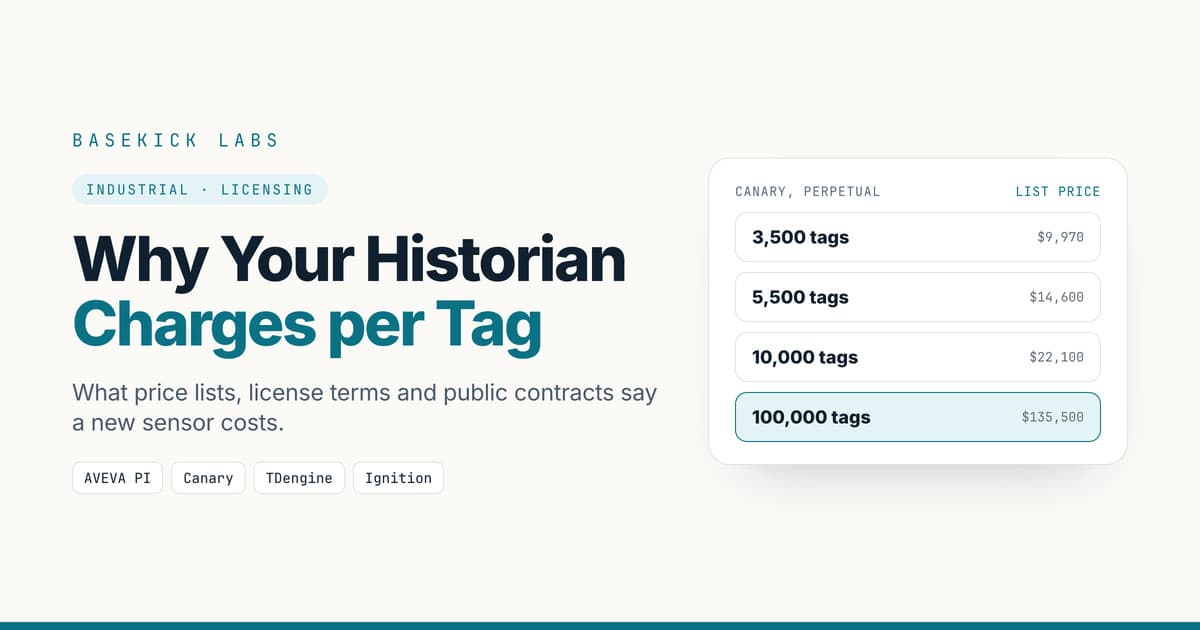
The steps are big. Canary's published perpetual license prices (before the 18% CustomerCare) are $9,970 for 3,500 tags, $14,600 for 5,500, $22,100 for 10,000 and $135,500 for 100,000. Going from 3,500 tags to 5,500 costs $4,630. The average per tag falls as you grow ($2.85 at 3,500, $1.36 at 100,000), but you only get there by buying the next step.
Derived signals count too. Canary's licensing guide: "Tag licenses are consumed by tags being logged into the Historian from various Canary Collectors or by the Calculation service" (guide). A calculated efficiency or a rolled-up flow total that you store is a tag you pay for. (Canary's Virtual Views don't consume a license, and an unlimited-tag license is available.)
Quiet tags still count. "The license count in the Canary Historian is determined by the total number of tags in the most recent HDB file of each DataSet, even if a tag is not receiving updates" (guide).
Releasing a tag hides its history. From the same page: "When a tag has been released from the license count, all historical data records remain in the Canary Historian but are no longer accessible for any client tools." To stay under your count, you give up read access to data you already collected.
AVEVA's aggregate tag model meters daily. For PI Data Infrastructure, the Aggregate Tag model requires every PI Server included in the model "to report the daily tag count to CONNECT" (AVEVA's cloud platform). You commit to a minimum tag tier with a monthly fixed charge. Go above it and you "shall be additionally charged Daily at the pre-set Overage Daily Rate". And: "Under no circumstances may Customer decrease or downgrade the Aggregate Tag Tier Benchmark during the Term" (AVEVA Software Schedule, §3.3(a)(iii)). In the non-reporting variant, the tag count "shall not exceed" the tier "unless an amendment to the Order Form has been executed" (§3.3(a)(iv)).
So the commitment only moves one way during a term. Decommission half a line and the tier you committed to stays where it was.
Two public records
Historian pricing is rarely public. Utilities are the exception, because their spending goes before public boards.
Holland Board of Public Works, Michigan, 2015. OSIsoft's budgetary quotation for the Holland Energy Park reads: "The one-time license cost to add a 10,000 tag PI Server ... is $103,450 with an annual support (SRP) cost of $15,518" (quotation). The largest line is "PI Server (10,000 points)" at $85,000.
Clients are priced separately: ten PI Coresight licenses at $995 and ten PI DataLink licenses at $350. An optional PI System Access license, which lets other applications read the data, adds $33,000 plus $4,950 a year. Support renews at "15% of then-current list price".
That is a 2015 quote for one site, not a current price. What it shows is the shape: the server is priced by points, every person who looks at the data is priced again, and letting other software read your own data is priced a third time.
Riverside Public Utilities, California, 2016. Riverside signed a PI enterprise agreement priced a different way: by asset. The pricing table lists electric smart meters at "$1.00 ... Per Meter" and water meters at $4.85, with phasor measurement units at $2,700. In exchange, "Licensee may use unlimited copies and quantities of Enterprise Licensed Software (including Datastream Points)" for data generated by those licensed assets, up to each asset's licensed capacity (agreement). The 2021 renewal, for license and services through August 2026, ran five years "in the amount of $1,212,333", about $242,467 a year (board memo).
Riverside still pays for growth. The meter just moved from points to meters. Which is the interesting part.
Why per tag? Nobody says
I looked for a vendor explaining why it prices per tag, and I couldn't find one from AVEVA, Canary, GE or Rockwell. What the record does show is this.
The tag is the unit of configuration, so it is the unit of work, and it scales with the size of the plant. That makes it an easy thing to count and an easy thing to sell against.
It is not a technical necessity. The same vendor that prices PI by points (OSIsoft, now AVEVA) sold Riverside unlimited points for its licensed assets, priced by asset.
The clearest evidence comes from TDengine, which prices the same engine two ways. Its historian package, with asset models and an analytics UI, is sold per tag. Its database alone, TDengine TSDB-Enterprise, is sold per core: $5,000 a year for 2 cores, up to $80,000 for 32 (pricing; we compared the two in our TDengine benchmark). The per-tag package adds IDMP, TDengine's asset-model and analytics layer, on top, but the storage engine is the same. My read: the meter follows what each buyer is used to paying for. Per-tag pricing survives because historian buyers expect it and because it tracks the value of the plant, not because a tag costs the vendor anything in particular to store.
What historians earn their price for
Per-tag pricing doesn't make historians bad products. They have real strengths that a general time-series database has to answer for.
- Collection. PI ships interfaces for OPC DA and HDA (the older Windows-based standards) and OPC UA. Its OPC UA connector maps "static OPC UA variables" to "PI Asset Framework elements and attributes" and converts dynamic variables to PI points (docs). Proficy lists OPC DA, HDA and UA collectors plus OPC HDA servers.
- Compression tuned to the instrument. Deadband and swinging-door settings in engineering units, per point. That is decades of process-engineering knowledge built into the product.
- Asset models. PI Asset Framework, Canary Virtual Views and TDengine IDMP give you equipment hierarchies and templates, so a calculation is defined once per pump type, not once per pump.
- Longevity. Canary was founded in 1985, and plants run these systems for decades.
If those are what you need, a historian is worth paying for. The question is whether the tag is the right thing to pay for.
How we price Arc
Arc Enterprise is priced per core and per machine and never counts tags, series or rows: $5,000 a year for up to 8 cores on one machine, $15,000 for up to 32 cores on up to five machines, $40,000 for up to 128 cores (pricing). Arc OSS is free under AGPL-3.0 with no limits.
Per core still meters something. A bigger workload needs more cores, and more cores cost more. What changes is the unit. Instrumenting another pump, keeping a calculated KPI, or leaving a decommissioned line's history readable doesn't change the bill. The hardware your workload needs does.
Arc reads plant data from OPC UA through Telegraf or MQTT, stores it as Parquet files you own, and answers SQL. It does not replace a historian's asset framework, and we don't claim it does. For teams whose historian bill is the reason they instrument less, it changes the question from "can we afford the tag?" to "do we have the hardware?". More on that in Arc for manufacturing and IIoT.
If a historian renewal or a tag true-up is on your calendar, talk to us before you sign. Send us your tag count, sample rates and how long you keep the data, and we'll tell you how many cores Arc needs to run it and what that costs. If you'd rather kick the tires first, Arc OSS is a single binary and free.
Prices and terms as published on November 16, 2026. Links go to the vendors' own pages and to the public records. If something has changed, let us know and we'll update the post.