
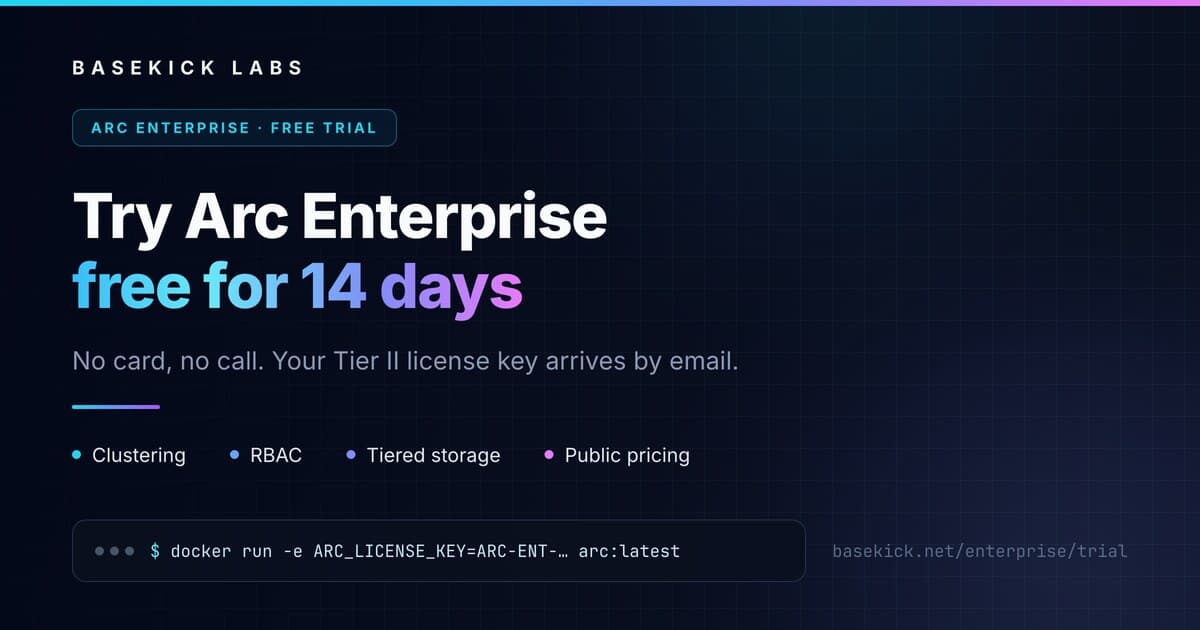
In September we put Arc Enterprise on the website: pick a tier, pay, get a key. One thing still went through an email to us, and it was the step that matters most before buying: the trial.
As of today it doesn't. Go to basekick.net/enterprise/trial, enter your name, company, and email, and a 14-day Arc Enterprise license key is in your inbox, usually within a minute. No card, no call, no form that turns into a calendar invite.
We also shipped a page we should have had a long time ago: basekick.net/pricing, with every price in one place.
The trial was the last form
When we opened online checkout, we kept the trial behind sales on purpose. The reasoning was that a trial goes better when someone on our side knows what you are testing. That is still true. It just should not be a gate.
The people asking for a trial were the same people who bought online without talking to us: they had already run Arc OSS, read the docs, and knew what they wanted to test. Clustering, mostly. Making them write an email and wait for a reply to try a feature they had already read about was the same tax we removed from buying. So we removed it here too.
If you do want help with your evaluation, reply to the trial email. It reaches the people who build Arc.
How the trial works
You fill in three fields, and the license key arrives by email together with a command to run it:
docker run -d --name arc \
  -p 8000:8000 \
  -e ARC_LICENSE_KEY="ARC-ENT-XXXX-XXXX-XXXX-XXXX" \
  -v arc-data:/app/data \
  ghcr.io/basekick-labs/arc:latest
It is the same image as Arc OSS. The key is the only difference. Arc activates it online on first start, and Kubernetes and the native packages take the same ARC_LICENSE_KEY, as the Getting Started guide shows. If you already run Arc OSS, add the key to the node you have and restart it. Your data and configuration stay where they are.
The trial is a Tier II license, which is where most of the interesting features start:
- Multi-node clustering
- RBAC and audit logging
- Tiered storage
- Query governance and management
- Scheduled continuous queries and retention
- Up to 32 cores across up to 5 machines
A few rules keep it fair:
- 14 days, then it ends. Paid licenses get a 14-day grace period past the term so a late renewal does not interrupt anything. Trials do not; they stop on the date in the email.
- One per person and one per machine. Asking again with the same address re-sends your key while the trial is active. A machine that already ran a trial cannot activate a second one.
- Online activation only. The server has to see the trial to end it, so trials cannot use an offline license file.
- No support agreement. You get the Tier II features, not the Tier II support line. You can still reply to the email with questions.
Why the key only arrives by email
The form never shows you the key. It goes to the address you typed, which is how we know the inbox is yours. That is also why we block temporary inboxes: a trial sent to a mailbox that disappears in ten minutes helps nobody. Gmail and other personal addresses are fine.
Behind the form, the website asks our license server for the trial through an API key that can do exactly one thing: create trials. The server decides what a trial is, not the website, so the tier, the 14 days, and the one-per-inbox rule live in one place.
When the 14 days are up
If Arc did what you needed, buy Tier I or Tier II online, swap the new key into ARC_LICENSE_KEY, and restart. Nothing else changes: same binary, same data, same configuration.
If you need more time, or you want to evaluate Tier III features such as automatic writer failover, or you run an air-gapped site, email enterprise@basekick.net. Those still go through us, because they genuinely benefit from a conversation.
A pricing page, finally
Until now our prices lived halfway down the Enterprise page. basekick.net/pricing puts everything side by side: Arc OSS, which is free under AGPL-3.0 with no row, data, or time limits, and the four Enterprise tiers with their cores, machines, and support. There are no usage fees anywhere on it. You pay per core band per year, not per row, query, or gigabyte.
| Tier | Price | Cores | Machines | Buy |
|---|---|---|---|---|
| Tier I | $5,000 / year | Up to 8 | 1 | Online |
| Tier II | $15,000 / year | Up to 32 | Up to 5 | Online |
| Tier III | $40,000 / year | Up to 128 | Production + staging | Sales |
| Unlimited | Custom | Unlimited | Unlimited | Sales |
A correction
In the September post we wrote that Tier I and Tier II "differ in capacity and support, not in what the binary can do." That was wrong, and the docs said the same. The tiers do unlock different features:
- Tier I covers a single server: RBAC, audit logging, and scheduled continuous queries and retention.
- Tier II adds clustering, tiered storage, and query governance.
- Tier III adds automatic writer failover, shared-storage multi-writer, SSO, and backup and restore.
Arc enforces this: a Tier I key does not turn on clustering. The pricing page, the Enterprise page, and the Licensing docs now all say so, and the trial gives you Tier II so you can test the features most people are buying for.
Try it
The form is at basekick.net/enterprise/trial. Fourteen days is enough to point Telegraf at a three-node cluster, run your real queries, and know whether Arc Enterprise fits. If it does, the buy button is one click away. If it does not, tell us why. We read every reply.