
We've published updated ClickBench results comparing Arc vs ClickHouse (Parquet) with true cold runs on multiple AWS instances. Arc won on every machine tested. Read the new post →
This article has been updated with corrected benchmark results. Our original submission had filesystem cache flushing incorrectly configured, which wasn't intentional or an attempt to gain unfair advantage. After the ClickBench maintainers raised concerns, we immediately investigated, fixed the issue, and re-ran all benchmarks with proper compliance.
The updated results in this article reflect the correct implementation with filesystem cache properly flushed before cold runs, all query result caches disabled, and full adherence to ClickBench rules. With the corrected methodology, Arc's cold run performance is approximately 3x slower than our initial results (120.25s vs 37.33s). Arc demonstrates competitive performance on ClickBench, performing well against QuestDB and TimescaleDB across multiple hardware configurations.
We're committed to transparent and honest benchmarking, and we appreciate the ClickBench team's diligence in maintaining benchmark integrity.
It's been crazy the last few weeks since we released the code of Arc Core (OSS) on GitHub on October 7. But as you read in the first blog post, Arc is a project that's been in the works for 3 years, and now, with the release of the code, we felt ready to compare Arc against the giants of the time series industry.
And the way we did that was using ClickBench, a benchmark tool widely recognized in the industry to prove the speed of the systems being tested.
Before going into the actual numbers, let me share what I feel about benchmarks—they're a vanity metric, something you can claim, but in reality there aren't many use cases that need, for example, 2.42M RPS. Based on my experience, I've only found a very small number of corporations, like streaming ones, that ingest around that.
But also, that doesn't mean that because only a small number of projects need that level of performance, the software should be slow or not take performance into consideration. Also think that competition elevates us, makes us better, and in that sense it's clear we enjoy these results, but also, they set the north star to chase the improvements we need to make.
That said, let me introduce you to the numbers that show how Arc performs against other time series databases.
Arc's Performance on ClickBench
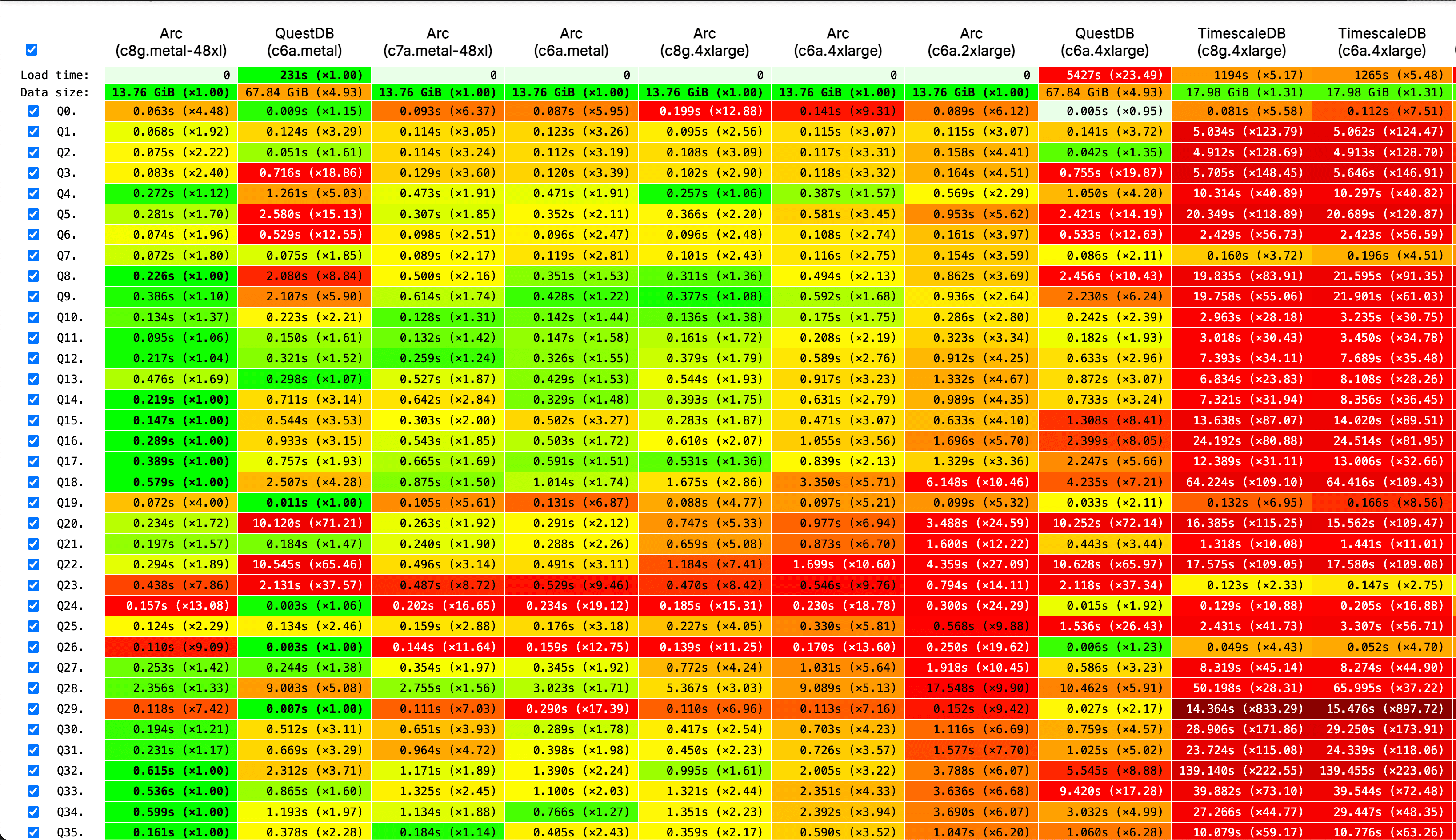
With the corrected benchmark methodology, Arc demonstrates exceptional performance on the c6a.4xlarge instance (AWS EC2, 16 vCPUs, 32GB RAM, gp2 500GB storage), which is the standard configuration for ClickBench comparisons.
Performance Comparison
Here are the head-to-head results on c6a.4xlarge (AWS EC2, 16 vCPUs, 32GB RAM):
Combined (Geometric Mean):
- Arc: 1.49x faster than baseline
- QuestDB: 1.54x faster than baseline
Cold Run Performance (with proper cache flushing):
- Arc: 1.58x faster than baseline
- QuestDB: 2.14x faster than baseline
Hot Run Performance:
- Arc: 1.68x faster than baseline
- QuestDB: 1.22x faster than baseline
Storage Efficiency:
- Arc: 14.77 GB (Parquet format, converted from 13.76 GiB)
- QuestDB: 72.84 GB (converted from 67.84 GiB)
- TimescaleDB: 19.30 GB
- Arc uses 4.93x less storage than QuestDB
- Arc uses 1.31x less storage than TimescaleDB
You can see the current values and detailed query-by-query results on the ClickBench site
Ok, we got it, you are doing pretty well, what's the secret?
Something that gives us an advantage is the design decisions we made when we started building Arc, we didn't try to reinvent the wheel, we built on the shoulders of DuckDB, which we chose as our SQL engine.
But also, we chose MessagePack, which offers incredible performance, and if we combine that with zero-copy passthrough with the columnar format of Parquet that are part of the core of Arc, it allows us to process 2.42M requests per second.
At the query level, Arc supports two output formats optimized for different use cases. For large datasets and high-throughput scenarios, we use Apache Arrow with zero-copy in columnar format to deliver data blazing fast. For smaller datasets and simpler integrations, we also support JSON output, which actually outperforms Arrow in those cases due to lower serialization overhead. The ClickBench results shown here were achieved using our JSON endpoint, demonstrating that Arc performs exceptionally well regardless of the output format you choose.
In the middle, we implemented our own set of procedures to avoid locking the system and to do proper multi-threading in a bunch of processes, like compaction or WAL, to offer data durability with just a little bit of overhead.
This is just the beginning and we're just starting, with the premise of offering something really performant that can scale and isn't a monster (right now Arc is approximately 5,500 lines of code).
What can you build with Arc?
Now, beyond the numbers, let me share what this performance means for real-world applications. Arc's speed isn't just about bragging rights—it's about unlocking use cases that were previously challenging or expensive to implement.
IoT and Smart Devices: Imagine you're managing millions of sensors sending data every second. With Arc's 2.42M RPS ingestion capability, you can handle massive IoT deployments without breaking a sweat. Whether it's smart cities, industrial sensors, or connected vehicles, Arc can ingest, store, and query your telemetry data in real-time without requiring a massive infrastructure investment.
Logistics and Supply Chain: Track your entire fleet, warehouse operations, or shipment movements with millisecond-level precision. Arc's query speed means you can run complex analytics on location data, delivery times, and route optimization in real-time, helping you make decisions faster and keep your operations running smoothly.
Aerospace and Aviation: When you're dealing with flight data, aircraft telemetry, or air traffic patterns, speed and reliability aren't optional. Arc can handle high-frequency aircraft sensor data, ground station telemetry, and flight operations analytics while giving you instant query responses for safety-critical decision-making.
Observability and Monitoring: If you're running modern cloud infrastructure, you know that observability data can quickly become overwhelming. Arc excels at ingesting metrics, logs, and traces at scale. The zero-copy columnar format means you can query across billions of data points to troubleshoot issues, analyze system performance, or detect anomalies without waiting around.
Financial Services and Trading: Market data, transaction logs, and trading signals generate massive time-series datasets. Arc's sub-millisecond query performance means you can run real-time analytics on market trends, backtest trading strategies, or monitor risk across your entire portfolio without compromise.
The key advantage? You get all this performance without the operational complexity. Arc's small footprint (5,500 lines of code) means fewer moving parts, easier debugging, and a system you can actually understand and maintain.
In the future
As I said, this is just the beginning and we're pumped to keep shipping features that will allow Arc to not only be the most performant, but the go-to option for time series/analytics use cases. The community has been responding—as of the time I'm writing this, we have 302 stars on GitHub in only 20 days since the Arc Core repo went live.
We've already answered more than 100 emails and comments all over the place asking about Arc, how it works, and what our plans are (roadmap coming soon).
We're sure we want to keep pushing in this direction, keep talking with the communities and potential new partners to shape Arc into something that solves your issues.
Get started with Arc
Ready to try Arc? Here's how to get started:
Check out the Arc Core repository on GitHub and star it if you find it interesting:
github.comBasekick-Labs/archttps://github.com/Basekick-Labs/arc
Join our growing community, ask questions, share your use cases, or contribute to the project. We're actively responding to issues, discussions, and are excited to hear what you're building.
Again, this is just the beginning. Thank you for the love we're getting, and don't forget to stay tuned to this blog to get news about Basekick Labs and Arc.
curl "https://dev30.ps.basekick.net/api/v3/query_sql"
--header "Authorization: Bearer apiv3_AikiQ0CSxq-tMu8yso5AjfpqYrLAOf85NwNqYwzLX9GjSsRNuQ3YREYxUly9zy3vwr0JbjzmgZ0MvXLKeneVqQ"